Types of Platforms and Key Features
Section outline
-
The guide Digital Tools for Energy Communities, published by the European Commission’s Energy Communities Repository (2023), provides an excellent overview of available tools, classifying them by function.
The main types of platforms include:
A) Platforms for Internal Management and Communication
A REC is first and foremost an organization of people. It needs tools for administrative management and member engagement.
- Features: Member registry management, accounting, voting, internal communications, document sharing.
- Practical Example: Som Comunitats (Spain). This is an online platform co-developed by several Spanish energy communities. It offers a “back-office” for administrative management (billing, accounting) and a “virtual office” area for members, where they can view their data, payments, and community activities. The platform is owned by the communities themselves, ensuring data sovereignty.
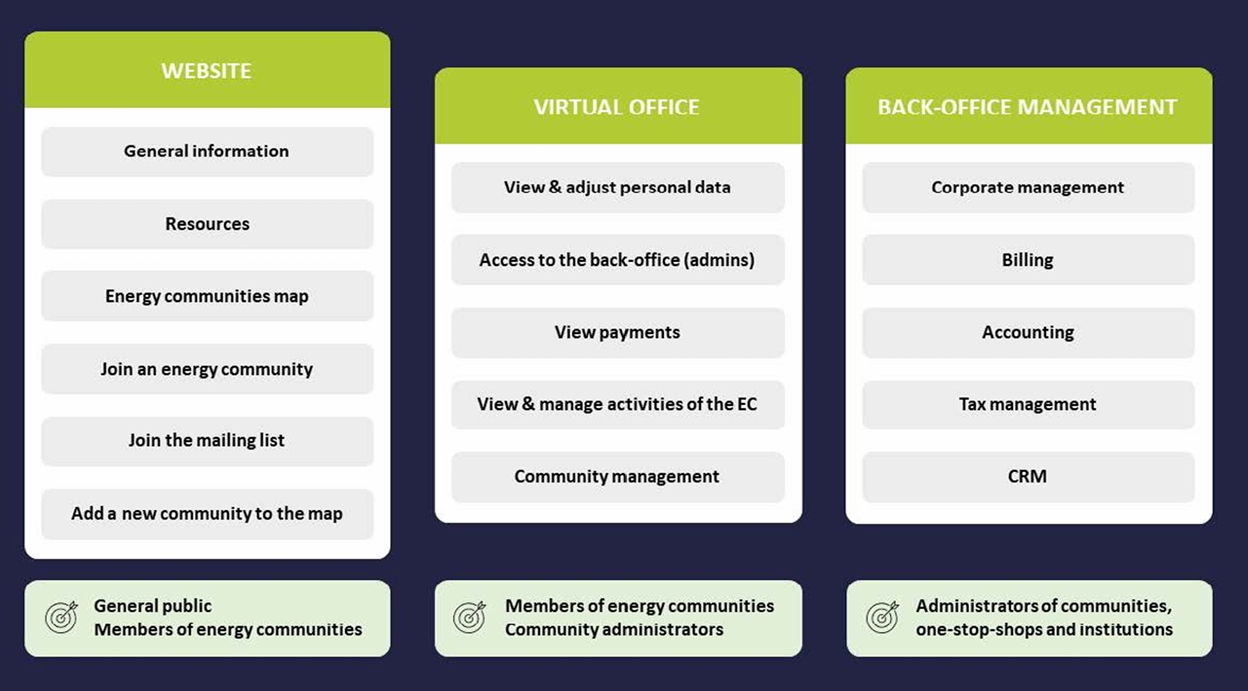
Structure of the Som Comunitats platform, integrating a public website, a reserved member area (Virtual Office), and an administration area (Back-Office Management). Source: Energy Communities Repository (2023).
B) Platforms for Energy Operations
These platforms constitute the technical “engine” of the REC. They focus on optimizing energy flows.
- Features:
- Monitoring: Real-time visualization of production, consumption, and storage charge status. EnergyID (Belgium and other EU countries) is an excellent example of a tool that allows individuals and communities to collect, analyze, and compare their energy data.
- Forecasting: Use of algorithms (often based on AI and machine learning) to predict photovoltaic production (based on weather) and members’ consumption profiles. The ComER project (Di Fazio et al., 2022) develops forecasting algorithms based on autoregressive methods (ARIMA) for aggregated community loads. The Magliano Alpi city project (Italy), in collaboration with the JRC, developed its own forecasting tool for this purpose.
- Optimization and Control: Development of control logics to decide when to charge or discharge batteries, when to activate flexible loads, etc. The goal is to maximize shared self-consumption and, consequently, economic benefits. Capillo et al. (2024) propose a Hierarchical Energy Management System (HEMS) using a combination of Fuzzy Logic and Genetic Algorithms to optimize CEC costs, outperforming simple local self-consumption approaches by 20%.
- Peer-to-Peer Trading: Enabling direct energy exchange. ENTRNCE Trader (Netherlands), developed by an affiliate of Alliander, allows producers and consumers to trade electricity directly.
- Flexibility Management: Interface with the grid to provide demand response services. PowerShaper (UK), managed by Carbon-Coop, is a service that allows remote control of user devices (electric vehicles, batteries) to provide grid flexibility in exchange for compensation.
Main source for this section: Energy Communities Repository, European Commission (2023). Digital Tools for Energy Communities – A Short Guide.