Module 3: Technical and Operational Aspects of RECs
Section outline
-
Energy Sharing Mechanisms and Grid Interconnections – Digital Tools and Platforms for the Management of RECs
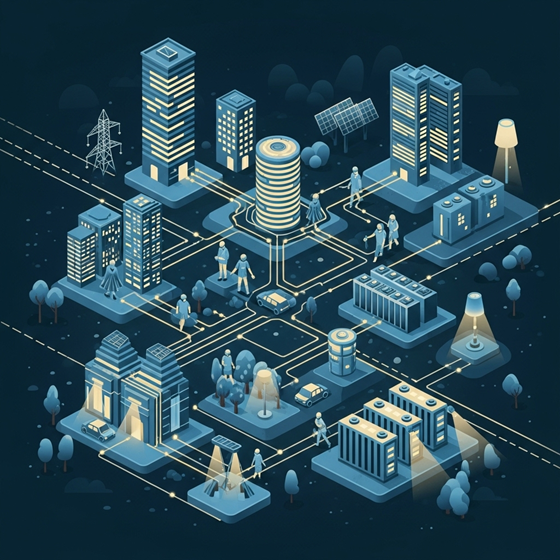
The interconnection of Energy Communities is not only technical but also social: every plant, every battery, every user becomes part of a living network. Through intelligent digital tools, energy stops being individual and becomes a collective resource.
-
The integration of thousands of small distributed generation sources, such as those of RECs, represents a significant challenge for the traditional electricity grid, designed for a unidirectional flow of energy from large power plants to passive consumers.
-
-
The historical electricity grid is a centralized system. The energy transition is imposing a paradigm shift toward a distributed model, which Lowitzsch et al. (2020) define as the emergence of "renewable energy clusters" (RE clusters). These clusters are the technical-engineering representation of what RECs represent from a socio-economic perspective.
The main technical challenges include:
- Bidirectional Energy Flows: Energy produced by RECs is injected into the grid, reversing the traditional flow. This can cause voltage management issues and overloads on low- and medium-voltage networks.
- Intermittency of Renewable Sources: Solar and wind production is variable and non-programmable, creating potential imbalances between supply and demand at the local level.
- Congestion Management: During periods of high production (e.g., at noon on a sunny day) and low local consumption, the grid can become congested, requiring plant curtailment or the implementation of storage systems.
To address these challenges, the grid must evolve and become "smart."

-
-
-
If Smart Grids are the physical infrastructure, digital platforms are the software that allows them to be managed intelligently. These tools are essential to transform a group of prosumers into a fully coordinated and optimized energy community.
-
-
To understand the role of digital platforms, it is useful to use the Flexibility-Centric Value Chain (FCVC) framework, proposed by Rodrigues et al. (2025). This model breaks down the process of providing flexibility (and, by extension, managing shared energy) into several phases, each supported by digital tools.
The main phases are:
- Flexibility Enablement: The phase in which a consumer equips themselves with the necessary technology (e.g., photovoltaic panels, batteries, heat pumps). Platforms can support this phase with simulators and feasibility assessment tools.
- Integration/Enablement: Installation of meters and configuration of energy management systems (HEMS/EMS) that allow monitoring and controlling devices.
- Aggregation: Platforms aggregate data and flexibility potential from multiple members to create a single manageable virtual entity.
- Negotiation Preparation: Tools analyze network needs and prepare offers to be submitted to local flexibility markets.
- Market Operation: Platforms facilitate market participation, submission of offers, and receipt of results.
- Activation & Settlement: Tools send activation commands to devices (e.g., “charge the battery now”) and manage accounting and revenue distribution.
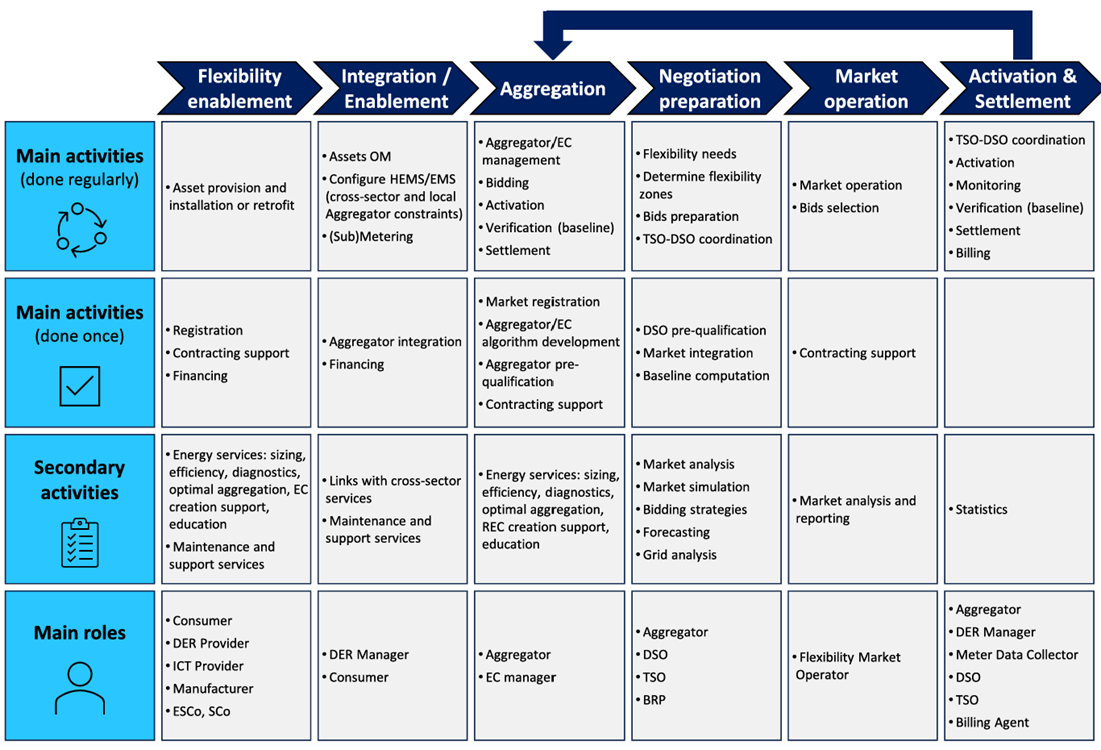
The Flexibility-Centric Value Chain (FCVC) shows the phases, activities, and roles needed to transform consumers’ flexibility potential into services for the grid. Source: Rodrigues et al. (2025).
-
-
-
The guide Digital Tools for Energy Communities, published by the European Commission’s Energy Communities Repository (2023), provides an excellent overview of available tools, classifying them by function.
The main types of platforms include:
A) Platforms for Internal Management and Communication
A REC is first and foremost an organization of people. It needs tools for administrative management and member engagement.
- Features: Member registry management, accounting, voting, internal communications, document sharing.
- Practical Example: Som Comunitats (Spain). This is an online platform co-developed by several Spanish energy communities. It offers a “back-office” for administrative management (billing, accounting) and a “virtual office” area for members, where they can view their data, payments, and community activities. The platform is owned by the communities themselves, ensuring data sovereignty.
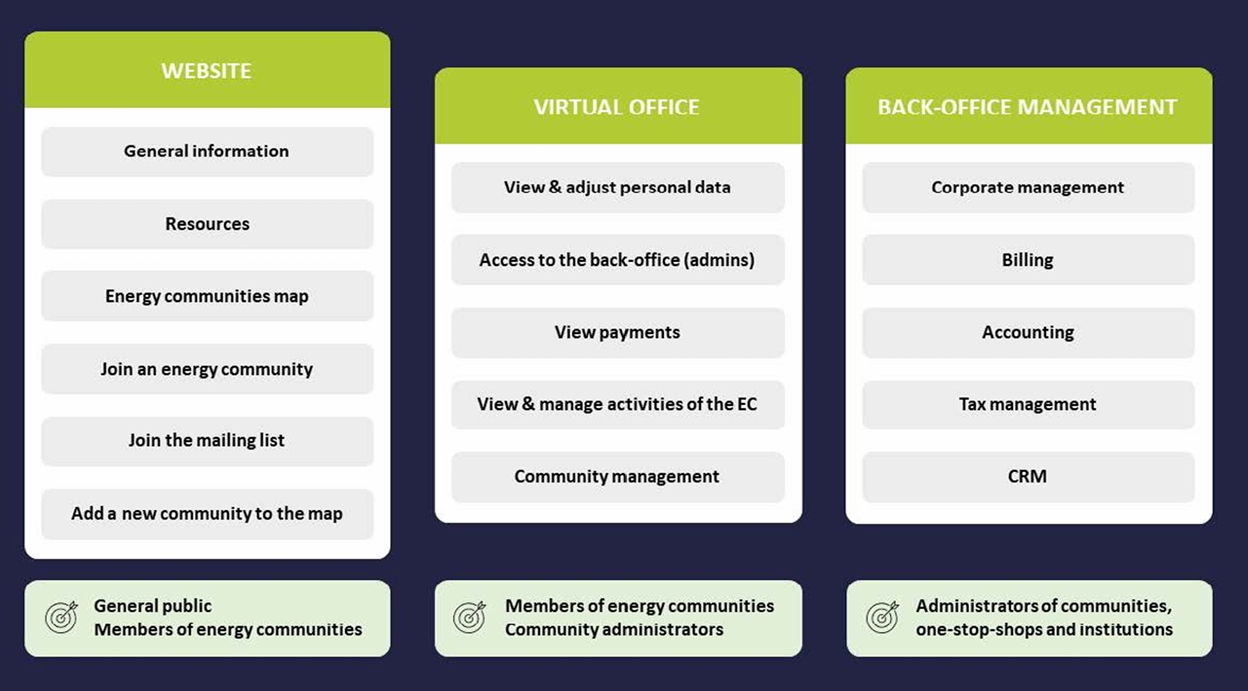
Structure of the Som Comunitats platform, integrating a public website, a reserved member area (Virtual Office), and an administration area (Back-Office Management). Source: Energy Communities Repository (2023).
B) Platforms for Energy Operations
These platforms constitute the technical “engine” of the REC. They focus on optimizing energy flows.
- Features:
- Monitoring: Real-time visualization of production, consumption, and storage charge status. EnergyID (Belgium and other EU countries) is an excellent example of a tool that allows individuals and communities to collect, analyze, and compare their energy data.
- Forecasting: Use of algorithms (often based on AI and machine learning) to predict photovoltaic production (based on weather) and members’ consumption profiles. The ComER project (Di Fazio et al., 2022) develops forecasting algorithms based on autoregressive methods (ARIMA) for aggregated community loads. The Magliano Alpi city project (Italy), in collaboration with the JRC, developed its own forecasting tool for this purpose.
- Optimization and Control: Development of control logics to decide when to charge or discharge batteries, when to activate flexible loads, etc. The goal is to maximize shared self-consumption and, consequently, economic benefits. Capillo et al. (2024) propose a Hierarchical Energy Management System (HEMS) using a combination of Fuzzy Logic and Genetic Algorithms to optimize CEC costs, outperforming simple local self-consumption approaches by 20%.
- Peer-to-Peer Trading: Enabling direct energy exchange. ENTRNCE Trader (Netherlands), developed by an affiliate of Alliander, allows producers and consumers to trade electricity directly.
- Flexibility Management: Interface with the grid to provide demand response services. PowerShaper (UK), managed by Carbon-Coop, is a service that allows remote control of user devices (electric vehicles, batteries) to provide grid flexibility in exchange for compensation.
Main source for this section: Energy Communities Repository, European Commission (2023). Digital Tools for Energy Communities – A Short Guide.
-
-
-
Research and innovation projects funded by the EU, such as those under the Horizon 2020 program, have been a crucial laboratory for the development and testing of digital tools for RECs. The paper "Energy Communities: How Tools Can Facilitate Their Enhancement" (Cuneo et al., 2021) presents the results of four major projects, showing different but complementary approaches.
Table 1: Summary of digital tools developed in H2020 projects
Project Name
Main Function of the Tool/Platform
Key and Innovative Aspects
MUSE GRIDS
Development of a "multi-objective smart controller" for managing multi-energy systems (electricity, heat, water).
Integration of multiple energy vectors to maximize synergies (e.g., using PV surplus to pump water). Use of data visualization tools to increase user engagement.
COMPILE
Creation of a set of technical and non-technical "toolsets" for creating and managing energy communities, especially in remote or weakly connected areas ("energy islands").
Enabled the installation of PV capacity 10 times higher than initially planned by the DSO thanks to smart controllers (HomeRule) and curtailment algorithms. First trial in Slovenia of "island mode" operation with a community battery.
MERLON
Development of an Integrated Local Energy Management System (ILESEM) combining IoT solutions at the prosumer level with back-end systems for optimization.
Multi-level approach (prosumer, aggregator, DSO). Allows the REC to provide balancing services and participate in wholesale markets while preserving user comfort.
IELECTRIX
Development of innovative technical solutions to accelerate renewable integration in grids that need reinforcement ("energy islands").
Creation of a low-voltage network "digital twin" based solely on smart meter data. This model allows the DSO to analyze the network, estimate its capacity for additional PV, and develop demand response programs.
-
In this submodule, we explored the technical and digital aspects at the heart of a Renewable Energy Community’s operation. We saw how the European regulatory framework has created the conditions for energy sharing, transforming a legal concept into an operational reality through virtual sharing mechanisms.
We understood that connecting a REC to the grid is not a simple "plug," but a complex interaction requiring the transformation of the network itself into an intelligent, bidirectional, and flexible Smart Grid.
The core of this transformation lies in digital tools and management platforms. We analyzed how these tools are not simple software, but complex ecosystems covering the entire "value chain," from enabling individual members to interacting with energy markets. From community management platforms like Som Comunitats to advanced AI-based optimization tools developed in projects like COMPILE and MERLON, we saw how digitalization is the real engine of RECs.
-
- Boulanger, S., Jouvet, P.-A., & Ramos, J. (2021). Cooperative models for renewable energy communities: Lessons from Enercoop and other European experiences. Energy Policy.
- Capillo, A., Di Fazio, A., & Siano, P. (2024). A Hierarchical Energy Management System for Citizen Energy Communities Using Fuzzy Logic and Genetic Algorithms. Applied Energy.
- Cruz-De-Jesús, E., Marano-Marcolini, A., & Martínez-Ramos, J.L. (2024). Participation of Energy Communities in Electricity Markets and Ancillary Services: An Overview of Successful Strategies. Energies.
- Cuneo, A., Peruchena, C., & Tzavellas, P. (2021). Energy Communities: How Tools Can Facilitate Their Enhancement. Results from H2020 Projects (IELECTRIX, COMPILE, MERLON, MUSE GRIDS).
- Di Fazio, A., Romano, P., & Vaccaro, A. (2022). Forecasting Methods for Energy Communities: ARIMA-based Aggregated Load Models. Energies.
- Energy Communities Repository, European Commission (2023). Digital Tools for Energy Communities – A Short Guide. European Commission.
- European Union (2018). Directive (EU) 2018/2001 of the European Parliament and of the Council of 11 December 2018 on the promotion of the use of energy from renewable sources (RED II).
- European Union (2019). Directive (EU) 2019/944 of the European Parliament and of the Council of 5 June 2019 on common rules for the internal market for electricity (Internal Electricity Market Directive).
- European Union (2023). EU Action Plan for Grids. November 2023.
- Lowitzsch, J., Hoicka, C.E., & van Tulder, F.J. (2020). Renewable Energy Communities under the 2018 European Union Clean Energy Package – Governance Model for the Energy Clusters. Renewable and Sustainable Energy Reviews.
- Rodrigues, J., Marcolini, A., & Silva, M. (2025). The Flexibility-Centric Value Chain for Renewable Energy Communities. Energy Reports.