Business Model Archetypes: A Map for Every Community
Section outline
-
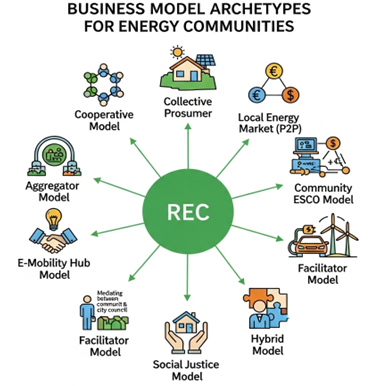
There is no "one-size-fits-all" model. Each community must choose and adapt the architecture that best suits its goals. Combining the archetypes study by MDPI (2023) with analysis of European models, we can identify the following main types:
1. Cooperative Model (or "REScoop.eu Model"): The historical and most widespread form. The REC is a member-owned cooperative with democratic decision-making ("one person, one vote"), aiming to provide services and benefits to its members, not to maximize profit.
2. Collective Prosumer Model: Typical of defined areas (apartment buildings, business districts). The objective is technical-economic: to maximize local self-consumption to minimize costs and dependence on the external grid.
3. Local Energy Market (P2P): An advanced model where members trade energy directly with each other (Peer-to-Peer) at agreed prices, using digital platforms, sometimes based on blockchain.
4. Aggregator / Market Player Model: The REC acts as a single virtual entity, aggregating member production and flexibility to offer services to the grid operator in exchange for remuneration (e.g., helping stabilize the grid during peaks).
5. Community ESCO (Energy Service Company) Model: In this archetype, the REC (or a commercial partner) offers a "turnkey" package to members (financing, installation, maintenance), paid back through a long-term contract (PPA) on the savings and incentives generated.
6. E-Mobility Hub Model: The REC specializes in installing and managing an EV charging infrastructure powered by local energy, creating a significant new revenue stream.
7. Facilitator Model (Public-Private): The REC (often promoted by a local authority, as seen in Covenant of Mayors examples) does not necessarily own the assets but acts as a facilitator: organizing collective purchases, offering technical advice, and helping members navigate bureaucracy.
8. Social Justice Model (or "POWERPOOR Model"): Here, the primary goal is to combat energy poverty. Funding is mainly public or philanthropic, and benefits are almost entirely directed at reducing the bills of vulnerable households. The return is measured in social terms (SROI).
9. Hybrid Model: Reality is often more complex. The most successful RECs are hybrids that evolve over time, combining elements from multiple archetypes.