Module 4: Economic and Financial Models for RECs
Section outline
-
Unlocking the potential of community energy: from economic sustainability to leadership in the Mediterranean.
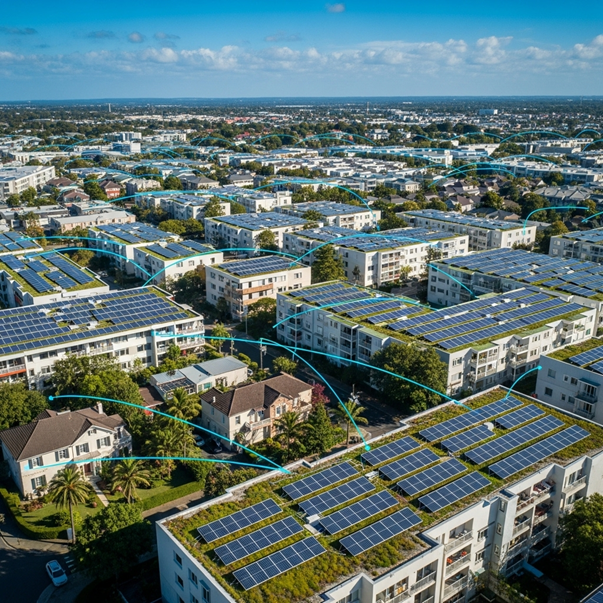
A practical guide to understanding, financing, and implementing successful Energy Communities, based on the latest analyses and European case studies. A pathway to transform citizens and businesses into key players in the energy transition.
-
-
-
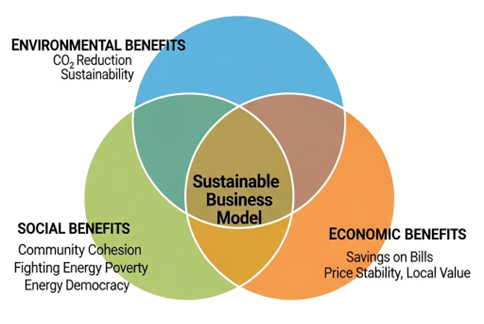
The first question to ask is: "What unique value are we offering our members and our community?" The answer is a portfolio of benefits, not a single element.
· Economic Value: The most immediate benefit. Through collective self-consumption, members see a direct reduction in their utility bills. Furthermore, a REC offers protection against the price volatility of the wholesale energy market, ensuring greater cost stability and predictability.
· Environmental Value: Members actively participate in the fight against climate change, contributing to national and European decarbonization goals. Every kWh produced and consumed locally is a kWh that does not need to be generated from fossil fuels.
· Social Value: Perhaps the most powerful and distinctive value. A REC strengthens community ties by creating a shared project. It is a formidable tool in the fight against energy poverty, allowing vulnerable households to access clean energy at lower costs—a key objective of European projects like POWERPOOR. Finally, it promotes energy democracy, giving citizens a say in an essential resource.
-
-
-
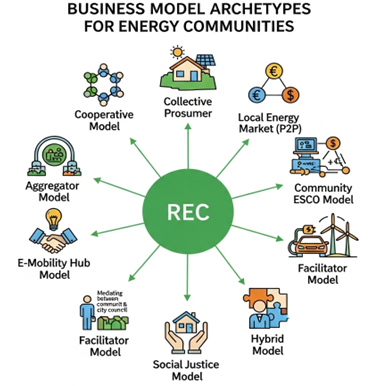
There is no "one-size-fits-all" model. Each community must choose and adapt the architecture that best suits its goals. Combining the archetypes study by MDPI (2023) with analysis of European models, we can identify the following main types:
1. Cooperative Model (or "REScoop.eu Model"): The historical and most widespread form. The REC is a member-owned cooperative with democratic decision-making ("one person, one vote"), aiming to provide services and benefits to its members, not to maximize profit.
2. Collective Prosumer Model: Typical of defined areas (apartment buildings, business districts). The objective is technical-economic: to maximize local self-consumption to minimize costs and dependence on the external grid.
3. Local Energy Market (P2P): An advanced model where members trade energy directly with each other (Peer-to-Peer) at agreed prices, using digital platforms, sometimes based on blockchain.
4. Aggregator / Market Player Model: The REC acts as a single virtual entity, aggregating member production and flexibility to offer services to the grid operator in exchange for remuneration (e.g., helping stabilize the grid during peaks).
5. Community ESCO (Energy Service Company) Model: In this archetype, the REC (or a commercial partner) offers a "turnkey" package to members (financing, installation, maintenance), paid back through a long-term contract (PPA) on the savings and incentives generated.
6. E-Mobility Hub Model: The REC specializes in installing and managing an EV charging infrastructure powered by local energy, creating a significant new revenue stream.
7. Facilitator Model (Public-Private): The REC (often promoted by a local authority, as seen in Covenant of Mayors examples) does not necessarily own the assets but acts as a facilitator: organizing collective purchases, offering technical advice, and helping members navigate bureaucracy.
8. Social Justice Model (or "POWERPOOR Model"): Here, the primary goal is to combat energy poverty. Funding is mainly public or philanthropic, and benefits are almost entirely directed at reducing the bills of vulnerable households. The return is measured in social terms (SROI).
9. Hybrid Model: Reality is often more complex. The most successful RECs are hybrids that evolve over time, combining elements from multiple archetypes.
-
-
-
-
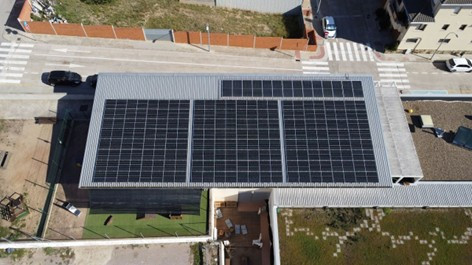
The cooperative Balenyà Sostenible in Catalonia is an example of rapid growth and remarkable impact. Established only in 2021, it has successfully launched numerous projects, from installing solar panels to creating a district heating system.
The Financial Model:
The secret to its swift development lies in a diversified and proactive financial strategy. From the outset, the community did not rely on a single funding source but built a solid mix:
· Public Funds as a Springboard: They actively sought and secured public funding at both national (like the CE Implementa programs) and European levels (Next Generation EU, Horizon 2020). This provided the essential initial capital to start the first projects and lend credibility to the initiative.
· Direct Community Involvement: To supplement public grants and finance further investments, they used grassroots financing tools like crowdlending. This allowed local citizens and supporters to lend money to the project, strengthening the bond with the territory and fostering a sense of shared ownership.
· Private Funding: To complete the financial picture, they accessed private funds to ensure full cost coverage for their ambitious projects.
In essence, Balenyà demonstrates how early access to public funds, combined with the ability to mobilize private and community capital, can exponentially accelerate a REC’s growth.
-
-
-
As the first officially recognized REC in Italy, Magliano Alpi is a pioneering model, especially for small and medium-sized municipalities. Its initial approach was to install a 20 kW photovoltaic system on the town hall's roof for energy sharing.
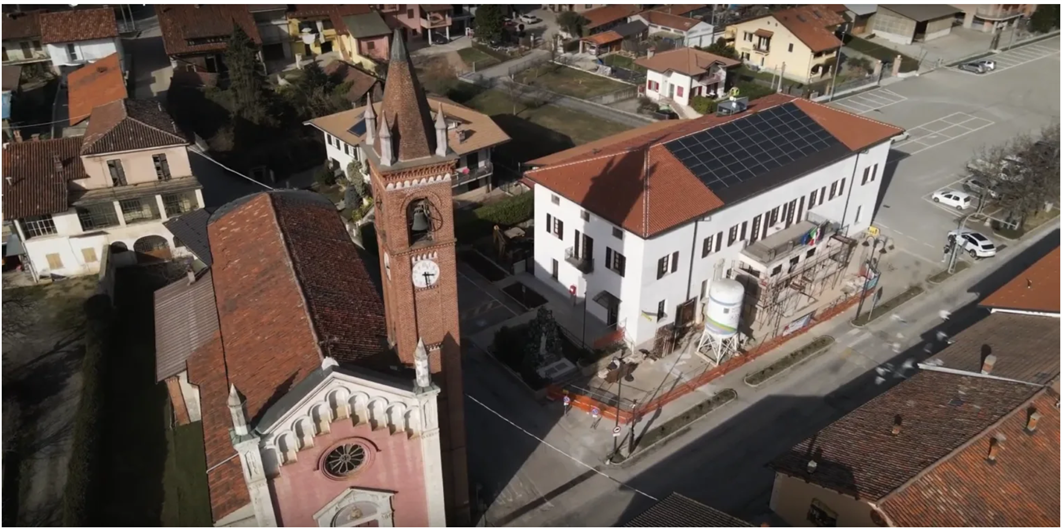
The Financial Model:
Magliano Alpi's financial model is a clear example of how a REC can thrive by intelligently exploiting the national regulatory and incentive framework. Its economic sustainability is primarily based on:
· National Incentives: The community strategically leveraged national incentives, such as the "Superbonus 110%," to encourage participation and cover initial investment costs. This drastically lowered the economic barriers for members to join.
· European and Regional Funds: The project was supported by funds from the Next Generation EU program and subsidies from local and regional governments, demonstrating a strong synergy between different levels of public administration.
For the future, the community plans to diversify its funding sources, looking at cooperative investment models, crowdfunding, and additional European grants. Their initial success, however, is a testament to how deep knowledge and strategic use of national policies can be the primary engine for launching a REC.
-
-
-
The ESEK energy community in Thessaly, Greece, is unique in its focus on transforming local residual biomass (from agriculture, forestry, and even recycled coffee grounds) into pellets for heating.
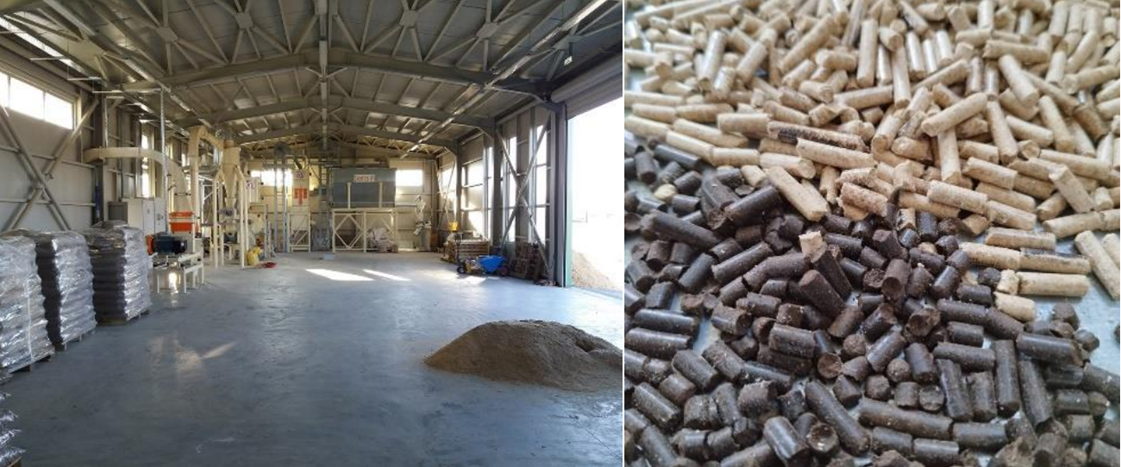
The Financial Model:
ESEK's financial journey is a model of self-reliance and organic growth, starting directly from the heart of the community.
· Initial Capital from Members: The first and most crucial step was initial funding through direct member contributions and access to traditional bank loans. This demonstrates strong trust and economic commitment from the founding community, which had "skin in the game" from day one.
· Mobilization of Local Resources: They collaborated closely with local authorities and organizations to optimize the use of resources, both material (biomass) and financial.
· Access to European Projects: Once its foundation was solid, ESEK began participating in European projects (like BECoop) to support innovation and expand its activities.
ESEK's model proves that it’s not always necessary to wait for large public grants to get started. A strong community commitment, combined with a solid business plan based on local resources, can be enough to gain the trust of banks and launch a successful project from the ground up.
-
-
-
The "Centrales Villageoises" is a national French framework, but the case of Val d'Eyrieux is an excellent Mediterranean application. This model aims to create a network of small, citizen-owned local companies to develop photovoltaic installations on rooftops.
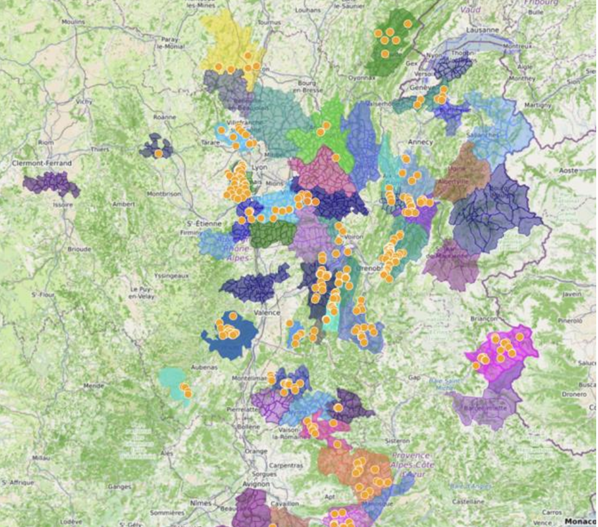
The Financial Model:
The financial heart of this model is direct citizen investment, where participants are not just members but true shareholders.
· Widespread Shareholding: The main source of capital comes from selling shares to citizens, local businesses, and public authorities. With over 7,250 shareholders across the network, this approach guarantees significant initial capital and, most importantly, a very strong sense of belonging and democratic governance.
· Reinvestment of Profits: A key principle of the model is that the majority of profits generated from selling energy are not distributed as dividends but are reinvested back into the community to develop new projects or services. This creates a virtuous cycle of self-sustaining growth.
· Complementary Sources: While citizen shareholding is the pillar, the model is supplemented by public funds and private financing (like crowdfunding) for larger-scale projects.
The Centrales Villageoises represent the "community finance" model par excellence, where capital is not just a tool but an integral part of the REC's social fabric and mission.
-
-
-
Case Study 5: Comunità Solare (Italy) - An Independent Model Funded by Corporate Social Responsibility
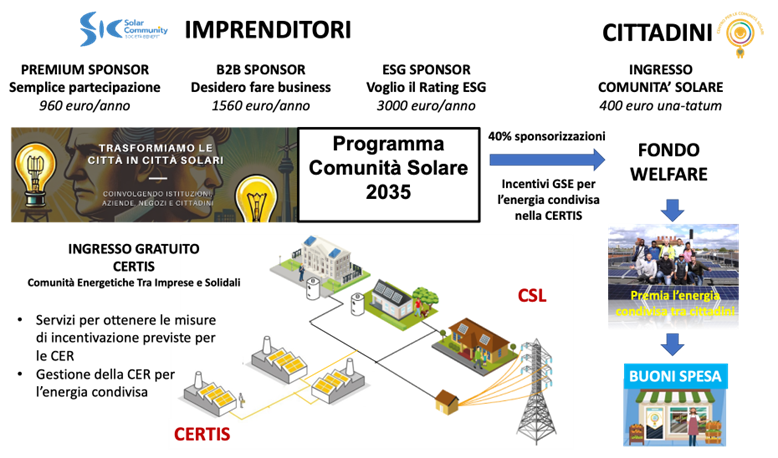
Comunità Solare, an initiative born as a spin-off from the University of Bologna, introduces a radically different model to the renewable energy community landscape. Through its "Comunità Solare 2035" program, it's described as Italy's first and only national technological platform for collective self-consumption. Its mission is to achieve true energy democracy by being completely independent of public grants or incentives for its own operation.
Its innovative structure relies on two synergistic entities: a non-profit association Centro per le Comunità Solari that unites its members, and a benefit corporation Solar Info Community srl SB that develops and manages the core technology and business relationships. This model has already mobilized thousands of families across dozens of local communities, treating energy not as a commodity, but as a local common good.
The Financial Model:
Comunità Solare's financial model represents a paradigm shift: instead of seeking funds, it offers a value-added service to the private sector. Its economic sustainability is built on a strategic relationship with local businesses, transforming their sustainability goals into a direct funding source for the community and promoting km 0 energy.
Corporate Sponsorship as an ESG Service: The model's engine is the Corporate Social Responsibility (CSR) service sold to local businesses. This engagement is often formalized through a Social Responsibility Pact (Patto di Responsabilità Sociale) signed with the local municipality. Through specific sponsorship packages, companies purchase a tangible ESG service that provides them with visibility, community engagement, and reportable data to improve their sustainability rating. The packages are structured in three main tiers:
Ø Premium Sponsor (€960/year): For basic participation and visibility in local communication materials.
Ø B2B Sponsor (€1,560/year): For businesses wanting to leverage the network, use the "Solar City Constructor" brand, and offer the platform's services to their own clients (e.g., PV installers).
Ø ESG Sponsor (€3,000/year): Includes all B2B benefits plus access to specialized reporting services and support for ESG questionnaires, directly linking their investment to measurable sustainability improvements.
The Premium Fund: A Virtuous Local Economic Loop: A significant portion (40%) of the sponsorship revenue is channeled into a social welfare fund (the "premium fund"). Critically, this fund is also sustained by the collective self-consumption incentives (from GSE) generated by the business and public administration communities (CERTIS and CERPAS). This dual-stream funding creates a robust resource pool to finance economic rewards for citizens who share their surplus energy. The rewards are distributed as shopping coupons redeemable at a wide network of local partners—from large supermarkets to small, historic town-center shops. This creates a powerful, self-sustaining economic loop that keeps value circulating directly within the local community.
Structured Community Platforms (CERTIS, CERPAS, and CSL): The model doesn't use a one-size-fits-all approach. Instead, Solar Info Community (SIC) manages three distinct technological platforms tailored to different stakeholders:
v CSL (Comunità Solare Locale): The core platform for citizens and families. They join to share energy from domestic PV systems or participate as consumers, receiving rewards from the premium fund.
v CERTIS (Comunità Energetiche Rinnovabili tra Imprese e Solidali): Designed for businesses. Sponsoring companies can join CERTIS to share energy, reduce their electricity bills, and donate their GSE incentives to the local social welfare fund. SIC also facilitates access to a 40% non-repayable grant for new PV installations for participating companies.
v CERPAS (Comunità Energetiche Rinnovabili Pubblica Amministrazione e Solidali): A platform for public administrations. It allows them to share energy from public PV installations to directly support vulnerable families and combat energy poverty, with the resulting GSE incentives entirely devolved to the welfare fund.
Shared Ownership through a Commitment Fee: To ensure active engagement and cover the initial technology costs, citizens pay a one-time contribution of €400 to join the CSL energy-sharing platform. This fee finances their personal smart meter, establishing a clear sense of co-participation and transforming members from passive consumers into committed "prosumers."
A Holistic Engagement Ecosystem:
To deliver maximum value to its sponsors and keep the community active, the model uses a comprehensive engagement strategy beyond simple energy sharing. This includes:
· Gamification: To foster a more active and engaged community, the model leverages gamification through the Solar Champions League. In this friendly competition, communities are ranked based on their self-consumption data, which promotes virtuous energy practices. The resulting vibrant and participatory platform becomes a valuable asset, justifying and encouraging continuous investment from sponsoring companies.
· Education: The Energy@School program engages primary schools to educate future solar citizens, embedding the culture of sustainability in the younger generation.
· Electric Mobility Integration: For top-tier sponsors, the model offers the chance to finance and brand tangible infrastructure, such as Community Chargers (EV charging stations), directly linking their investment to visible, functional pieces of the "solar city" infrastructure.
Comunità Solare proves that an energy community can achieve full financial autonomy by creating a compelling value proposition for the private sector. It moves beyond traditional funding models to build a self-sustaining ecosystem where corporate ESG goals, channeled through structured platforms like CERTIS and CERPAS, directly finance community benefits. This transforms the energy transition into a powerful driver for integrated, inclusive, and sustainable local development.
-
-
From the academic analyses of MDPI and the JRC, to the practical guides of SCCALE 203050 and REScoop.eu, and the field lessons from ENERGIZE, a consistent and powerful message emerges: the success of a REC is an art that balances social vision, technological innovation, and a solid economic-financial plan, enabled by the European Commission's regulatory framework.
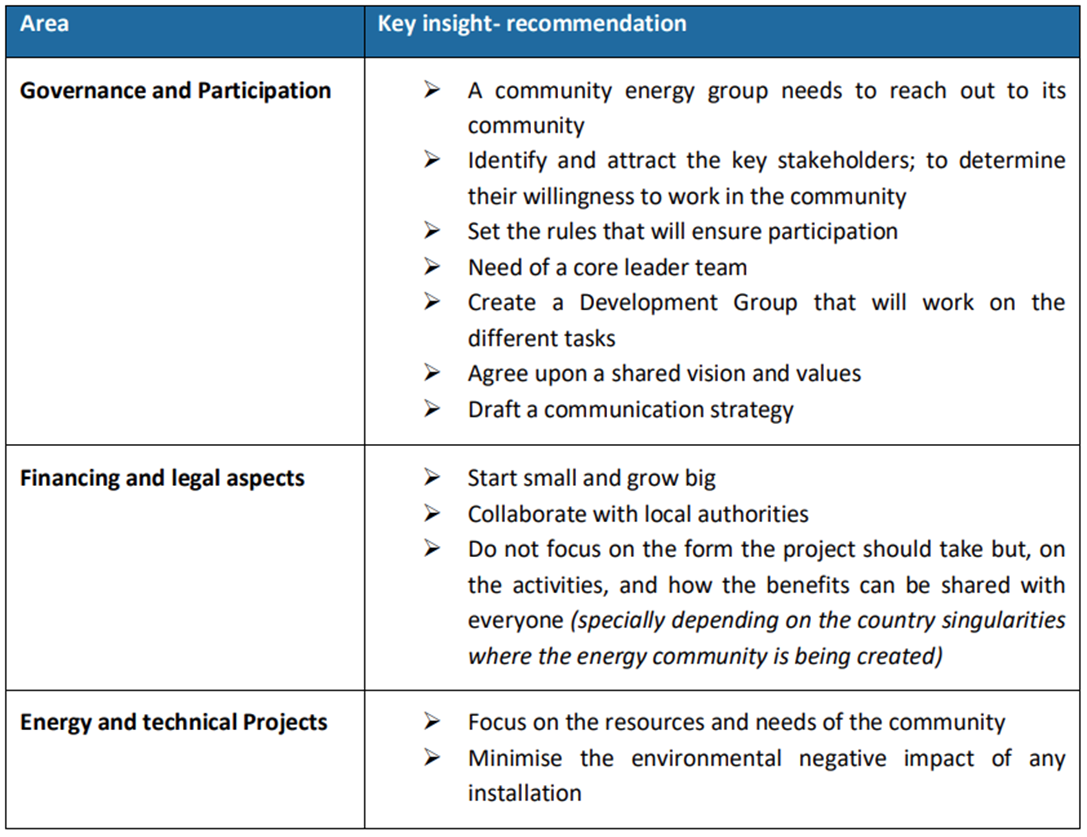
Your Key Action Points:
1. The Business Model is Your Strategy, Not a Static Document: Choose the archetype that best fits your community's identity but be ready to evolve it. Resilience lies in adaptability.
2. Finance is a Mosaic, Not a Monolith: Your strength will lie in strategically combining resources: member capital, public grants, loans, and operational incentives.
3. Management is Intelligence, Not Bureaucracy: Do not underestimate the importance of management tools. Investing in a good monitoring system means optimizing revenue, ensuring transparency, and freeing up time.
4. Impact is Your Real Currency: Whether your main goal is savings, decarbonization, or social justice, clearly define and measure the "value" you want to create. It will be your guiding star and greatest motivation.
RECs are no longer a niche experiment. They are the present and future of an energy system that is becoming more local, democratic, and clean. The energy transition is not something we endure; it is something we build, together. You now have the economic and financial tools to start building.
Are you ready to turn this knowledge into action and design the economic model for your Energy Community?
-
· Almendra Awerkin, Paolo Falbo, Tiziano Vargiolu, March 11, 2025: Optimal Investment and Fair Sharing Rules for Incentives in Virtual Renewable Energy Communities 2311.12055v2
· CEER (Council of European Energy Regulators). (2019) CEER Regulatory Frameworks Report
· COME-RES Project | Resource Hub - An H2020 project facilitating the development of energy communities. COME-RES | The Project
· Covenant of Mayors – Europe - The world's largest movement for local climate and energy action. Covenant of Mayors - Europe | Covenant of Mayors - Europe
· ENERGIZE. (2025) ENERGIZE-Review-of-existing-energy-communities.pdf
· Energy Communities Repository (European Commission) Energy Communities Repository - Homepage - European Commission
· Energy Community Secretariat Energy Community Homepage
· European Commission, DG-ENER. Energy communities
· European Commission. (2018). Directive (EU) 2018/2001 on the promotion of the use of energy from renewable sources (RED II) Directive - 2018/2001 - EN - EUR-Lex
· European Commission. (2019). Directive (EU) 2019/944 on common rules for the internal market for electricity. Directive - 2019/944 - EN - EUR-Lex
· JRC (Joint Research Centre), European Commission. (2020). Energy communities: an overview of energy and social innovation. JRC Publications Repository - Energy communities: an overview of energy and social innovation
· Lowitzsch, J., Hoicka, C. E., & van Tulder, F. J. (2020). Renewable Energy Communities—A Review of the Literature and a Proposal for a Business Model Framework. Energies, 13(18), 4724. MDPI. (A key reference study for business model archetypes). https://www.sciencedirect.com/science/article/pii/S1364032119306975
· National Recovery and Resilience Plan (PNRR), Italy. Italy’s recovery and resilience plan - European Commission
· POWERPOOR Project Front page | POWERPOOR
· RESCOOP. (2020). Community energy: a practical guide to reclaiming power. Community Energy: A practical guide to reclaiming power - REScoop
· RESCoop.eu - European Federation of Citizen Energy Cooperatives https://www.rescoop.eu
· RSE - Ricerca sul Sistema Energetico. (2024). Le Comunità Energetiche in Italia: Quadro normativo, peculiarità, tecnologie e strumenti a supporto, Le comunità energetiche in Italia - RSE
· SCCALE 203050. (2023). Financing guide for energy communities. Financing guide for energy communities - European Commission