Case Study 5: Comunità Solare (Italy) - An Independent Model Funded by Corporate Social Responsibility
Section outline
-
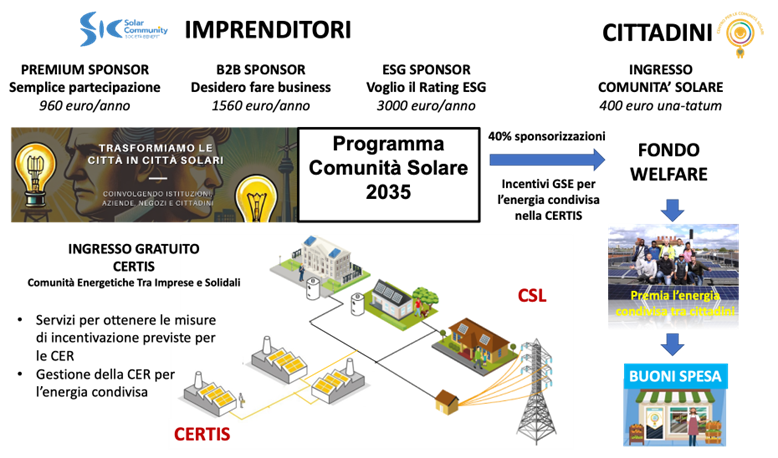
Comunità Solare, an initiative born as a spin-off from the University of Bologna, introduces a radically different model to the renewable energy community landscape. Through its "Comunità Solare 2035" program, it's described as Italy's first and only national technological platform for collective self-consumption. Its mission is to achieve true energy democracy by being completely independent of public grants or incentives for its own operation.
Its innovative structure relies on two synergistic entities: a non-profit association Centro per le Comunità Solari that unites its members, and a benefit corporation Solar Info Community srl SB that develops and manages the core technology and business relationships. This model has already mobilized thousands of families across dozens of local communities, treating energy not as a commodity, but as a local common good.
The Financial Model:
Comunità Solare's financial model represents a paradigm shift: instead of seeking funds, it offers a value-added service to the private sector. Its economic sustainability is built on a strategic relationship with local businesses, transforming their sustainability goals into a direct funding source for the community and promoting km 0 energy.
Corporate Sponsorship as an ESG Service: The model's engine is the Corporate Social Responsibility (CSR) service sold to local businesses. This engagement is often formalized through a Social Responsibility Pact (Patto di Responsabilità Sociale) signed with the local municipality. Through specific sponsorship packages, companies purchase a tangible ESG service that provides them with visibility, community engagement, and reportable data to improve their sustainability rating. The packages are structured in three main tiers:
Ø Premium Sponsor (€960/year): For basic participation and visibility in local communication materials.
Ø B2B Sponsor (€1,560/year): For businesses wanting to leverage the network, use the "Solar City Constructor" brand, and offer the platform's services to their own clients (e.g., PV installers).
Ø ESG Sponsor (€3,000/year): Includes all B2B benefits plus access to specialized reporting services and support for ESG questionnaires, directly linking their investment to measurable sustainability improvements.
The Premium Fund: A Virtuous Local Economic Loop: A significant portion (40%) of the sponsorship revenue is channeled into a social welfare fund (the "premium fund"). Critically, this fund is also sustained by the collective self-consumption incentives (from GSE) generated by the business and public administration communities (CERTIS and CERPAS). This dual-stream funding creates a robust resource pool to finance economic rewards for citizens who share their surplus energy. The rewards are distributed as shopping coupons redeemable at a wide network of local partners—from large supermarkets to small, historic town-center shops. This creates a powerful, self-sustaining economic loop that keeps value circulating directly within the local community.
Structured Community Platforms (CERTIS, CERPAS, and CSL): The model doesn't use a one-size-fits-all approach. Instead, Solar Info Community (SIC) manages three distinct technological platforms tailored to different stakeholders:
v CSL (Comunità Solare Locale): The core platform for citizens and families. They join to share energy from domestic PV systems or participate as consumers, receiving rewards from the premium fund.
v CERTIS (Comunità Energetiche Rinnovabili tra Imprese e Solidali): Designed for businesses. Sponsoring companies can join CERTIS to share energy, reduce their electricity bills, and donate their GSE incentives to the local social welfare fund. SIC also facilitates access to a 40% non-repayable grant for new PV installations for participating companies.
v CERPAS (Comunità Energetiche Rinnovabili Pubblica Amministrazione e Solidali): A platform for public administrations. It allows them to share energy from public PV installations to directly support vulnerable families and combat energy poverty, with the resulting GSE incentives entirely devolved to the welfare fund.
Shared Ownership through a Commitment Fee: To ensure active engagement and cover the initial technology costs, citizens pay a one-time contribution of €400 to join the CSL energy-sharing platform. This fee finances their personal smart meter, establishing a clear sense of co-participation and transforming members from passive consumers into committed "prosumers."
A Holistic Engagement Ecosystem:
To deliver maximum value to its sponsors and keep the community active, the model uses a comprehensive engagement strategy beyond simple energy sharing. This includes:
· Gamification: To foster a more active and engaged community, the model leverages gamification through the Solar Champions League. In this friendly competition, communities are ranked based on their self-consumption data, which promotes virtuous energy practices. The resulting vibrant and participatory platform becomes a valuable asset, justifying and encouraging continuous investment from sponsoring companies.
· Education: The Energy@School program engages primary schools to educate future solar citizens, embedding the culture of sustainability in the younger generation.
· Electric Mobility Integration: For top-tier sponsors, the model offers the chance to finance and brand tangible infrastructure, such as Community Chargers (EV charging stations), directly linking their investment to visible, functional pieces of the "solar city" infrastructure.
Comunità Solare proves that an energy community can achieve full financial autonomy by creating a compelling value proposition for the private sector. It moves beyond traditional funding models to build a self-sustaining ecosystem where corporate ESG goals, channeled through structured platforms like CERTIS and CERPAS, directly finance community benefits. This transforms the energy transition into a powerful driver for integrated, inclusive, and sustainable local development.